


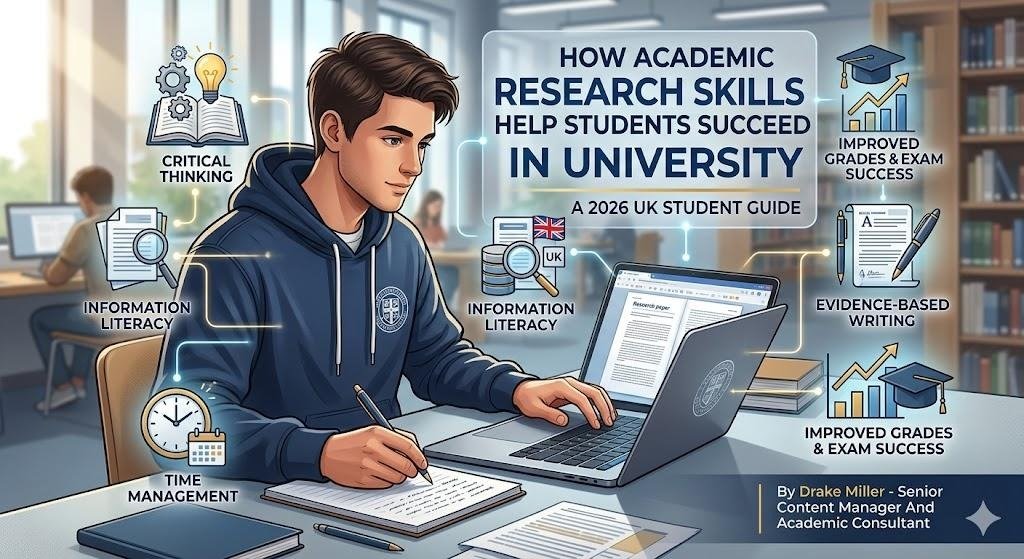
By Drake Miller – Senior Content Manager And Academic Consultant
The transition from sixth form or secondary school to university is often defined by a significant shift in academic expectations. While earlier education often focuses on foundational knowledge and exam-based reproduction, university demands a deeper, more critical engagement with information. Central to this evolution is the mastery of academic research skills. Far from being a niche requirement for future professors, these skills are the engine of undergraduate success, enabling students to navigate complex data, argue persuasively, and contribute to their chosen fields.
For students across the UK and globally, understanding how to harness these skills is often the difference between struggling with word counts and producing high-distinction work. This is especially true in technical disciplines; for instance, students often seek MATLAB assignment help to better understand how to research, model, and analyze complex datasets effectively. This guide explores the multifaceted benefits of academic research and how it serves as a cornerstone for both academic and professional excellence.
1. Enhancing Critical Thinking and Analytical Abilities
At its core, academic research is about inquiry. It teaches students not to take information at face value but to question the “how” and the “why.” When a student investigates a topic, they must evaluate the credibility of sources, identify biases, and recognize the difference between empirical evidence and subjective opinion.
In the UK higher education system, “Critical Analysis” usually accounts for a significant percentage of the marking rubric. This analytical rigor translates directly into better grades. A student who can dissect a peer-reviewed journal article and compare it with contemporary case studies demonstrates a level of cognitive maturity that markers look for in high-level assignments. This skill is particularly vital in an era of digital misinformation, where the ability to vet information is a necessary life skill.
2. Mastery of Evidence-Based Argumentation
University assignments are rarely about providing “the right answer.” Instead, they are about building the strongest possible argument based on existing data. Academic research provides the raw materials—the theories and precedents—needed to build a compelling case.
By learning how to integrate various perspectives, students move beyond simple descriptions and toward critical synthesis. Effective research skills allow you to:
- Identify gaps in current literature to find a unique “hook” for your essay.
- Support your claims with authoritative citations from recognized experts.
- Anticipate and refute counter-arguments, showing a balanced academic perspective.
For those requiring specialized support in structuring these arguments, seeking assignment help at Myassignmenthelp.com can provide the additional guidance needed to refine research methodologies and academic writing styles. This professional intervention helps students understand how to bridge the gap between gathering data and presenting it persuasively.
3. Information Literacy and Agentic AI in 2026
Information literacy is the ability to find, evaluate, and use information effectively. In a modern university setting, this means moving beyond a basic Google search. Students must become proficient in using institutional libraries, JSTOR, Google Scholar, and specialized databases.
In 2026, information literacy also involves the ethical use of Agentic AI. Unlike basic chatbots, AI agents can now assist in “mapping” a research field and identifying seminal papers. However, the true expertise lies in the human oversight. A successful student uses these tools to automate the sourcing process while maintaining the intellectual heavy lifting of analysis. Mastering advanced search operators and Boolean logic remains the foundational logic that allows students to guide AI tools toward the most relevant data points for their thesis.
4. Academic Integrity and the Art of Referencing
One of the most daunting aspects of university life is the strict adherence to referencing styles. Whether it be Harvard, APA, MLA, or OSCOLA, the UK system is notoriously rigorous regarding citation. Academic research skills include the meticulous habit of tracking sources from the moment they are discovered.
Understanding the “why” behind referencing—giving credit to original thinkers and allowing readers to trace your steps—fosters a culture of academic integrity. It protects students from the pitfalls of accidental plagiarism and builds a professional habit of acknowledging the intellectual labor of others. Using software like EndNote or Zotero early in your degree can save hundreds of hours during your final year.
5. Time Management and Project Organization
A 3,000-word research paper is essentially a project management task. Successful students break down the process into stages to avoid “last-minute panic.” A systematic approach usually involves:
- Topic Selection: Testing the waters to see if enough data exists.
- Annotated Bibliography: Summarizing sources to see how they fit together.
- Drafting & Integration: Weaving research into a narrative rather than just “listing” facts.
- Final Review: Ensuring all citations match the reference list.
Developing this workflow prevents burnout and ensures that the final submission is polished, well-supported, and submitted before the deadline—a crucial skill for maintaining high-distinction averages.
6. Preparation for the Dissertation and Beyond
For high school students looking ahead, or first-year undergraduates, it is important to realize that every small essay is a “practice run” for the final-year dissertation. The dissertation is the pinnacle of the undergraduate experience, requiring independent research on a massive scale.
Students who invest time in learning research skills early on find the dissertation process far less intimidating. They already know how to conduct a literature review, formulate a research question, and manage large bibliographies. This early preparation is often what separates a standard degree from a First-Class Honours degree.
7. Boosting Employability and Professional Skills
The value of research skills extends far beyond the campus gates. In the modern workforce, “Researcher” is a vital component of many roles, from Marketing Analysts and Policy Advisors to Software Developers and Journalists. Employers value graduates who can:
- Synthesize complex information quickly for stakeholders.
- Produce clear, evidence-based reports that drive business decisions.
- Identify trends and patterns in noisy data.
Frequently Asked Questions
Q.1 What are the most important research skills for university?
The most critical skills include information literacy (finding sources), critical analysis (evaluating sources), referencing (academic integrity), and synthesis (combining sources to create a new argument).
Q.2 How can I find reliable sources for my assignments in the UK?
Stick to peer-reviewed journals, books from academic publishers, and reputable government or organizational websites (.gov.uk or .org). Use your university’s online library portal rather than a general search engine.
Q.3 Is it okay to use Wikipedia for academic research?
Wikipedia is a great starting point to understand a topic generally, but it should not be cited as a primary source. Instead, scroll to the bottom of the Wikipedia page and look at the “References” section to find the original academic sources.
Q.4 How do I avoid plagiarism when doing research?
Always take notes in your own words and record the source immediately. Use quotation marks for direct speech and ensure every idea that is not your own is accompanied by an in-text citation in the required style (e.g., Harvard or APA).
About the Author: Drake Miller
Drake Miller is a senior content manager, academic consultant and higher education strategist with over 12 years of experience in student productivity and digital literacy. As a recognized blog author and expert in academic support, Drake utilizes the E-E-A-T (Experience, Expertise, Authoritativeness, and Trustworthiness) framework to ensure all content provides actionable, fact-backed guidance for the modern student. His work has helped thousands of students in the UK and US navigate the complexities of higher education through structured “Deep Work” methodologies and advanced SEO-driven academic resources.
